Dandelion and Periwinkle as seen in April 2013
This past week I was more than a little distracted by the news in Boston. I grew up in the Boston area – I used to go to the Boston Marathon as a child when it passed through Newton, cheering on the runners. I lived in Cambridge, worked at MIT and spent time in Watertown. I have many friends who live there. Despite my intense interest in the details, I have no desire to become a political blogger. I will refer you to the blog of my friend Daled Amos – he writes well, explains political topics if you want more information and has a background as a teacher. He often quotes other political bloggers.
I have hopes to write a Nature Notes post this week and maybe a recipe for rice salad. If not, they will show up next week. Meanwhile, a few notes of interest:
I had the opportunity to attend a lecture at Rutgers by Professor Maud Mandel on Muslims and Jews in France: Genealogy of a Conflict. In a tiny nutshell, her premise was to “question past monocausal explanations” (I believe she meant she was suggesting more than one cause). Her book is coming out in January 2014; here are a few of the causes she mentioned:
Jews from Algeria made citizens of France; Muslims were not. (1870)
North African Jews had welcome from established Jewish community; Muslims had no one, initially.
In 1968, Maoists (a group of Leftists) tried to convince Algerian Muslims to side with Palestine. The Maoists equated Palestine with Vietnam. At first, it didn’t work, but later it caught on.
For two years Muslims and Jews worked together on racism (SOS Racisme), but then that fell apart. (1984)
Rutgers Bildner Center for the Study of Jewish Life hosts free lectures like this one in the spring and fall; see Public Events.
I published an interview with marketing director David Rekuc: Blog Interview on Marketing, eCommerce and Edison, NJ. Looking to interview other central New Jersey business people, especially those who make good use of social media, websites and/or blogs.
Note about the photo: I love the combination of dandelions with all the purples of this season. I purposely left a few in my front yard, to complement the grape hyacinths, creeping phlox and purple deadnettle. The periwinkle/dandelion photo is actually in a yard a block from my home.
Spring has finally arrived in the form of striped purple crocuses. One of the names of the upcoming holiday of Pesach (also known as Passover) is Ḥag HaAviv or Holiday of Spring. An advantage of Passover coming early this year is the by the time the magnolias and dogwoods are in bloom, our Passover cleaning/cooking will be done, and we will better be able to enjoy the spring buds. Next year there will be an extra month of Adar so Passover will be later in the spring. If we didn’t have that extra month of Adar, we might be celebrating Pesach in the winter.
In renaming this blog, I had some ideas of settling into a particular niche. I’ve read oh how a proper blog should have a niche and stick with it. Well, I fear that may not come to be, as I have all sorts of ideas for this blog, and rarely are they consistently of one sort or another. A friend today gave me a poem she had written several years ago. It is somewhat biographical, and it also alludes some of the difficulties of the Sacrifice of Isaac. So stay tuned for that one. I have in mind to write a review of Ester and Ruzya, a wonderful book. Some ideas for interviews of other bloggers have come into my head on a particular topic – we will see if I follow through with that one. And once I get back to my art group, I suspect that art exercises and sketches will again be topics for blog discussions.
What can one say about a striped purple crocus? It’s symbolism seems to be universal, as it often pushes out of the ground before other flowers do (my neighbor’s snow drops appeared a while back, however). The word crocus is Greek, and it may have its roots in the Hebrew כרכום karkōm. I am guessing that this is a Crocus vernus.
Happy Pesach to those who celebrate. Happy Easter to those who celebrate that holiday. And happy spring of crocuses, forsythia, tulips and daffodils and whatever grows in your part of the world to all.
Leora’s note: I’m not sure how I first connected with Debra Walk, but we seem to have 22 friends in common on Facebook. I enjoy seeing her beautiful artwork, so I asked her a few questions to learn more. Enjoy.
[nggallery id=4]
1) When did you realize you wanted to be an artist?
I loved art from an early age, and my high school art teacher told me that I should seriously pursue art, but by the time I reached my teens, I somehow developed the idea that art was not a valuable profession and decided that I wanted to do something medically related as a profession, and art would be my hobby.
2) Please describe the work you do.
I’ve worked in various media over the years – calligraphy, paper cutting, polymer clay, and, most recently, fabric.
When I was younger, I loved the exactly measured type of calligraphy that I did then, but after a while, I felt a need to work in a softer and less exacting medium. I was living far away from my children and grandchildren at the time and wanted to make them things for them that they could cuddle with and wrap around themselves and not just hang on their walls. This led to my beginning to work with fabric.
My “bread and butter” work involves making Challah Covers and Platta Covers, and I guess they fall more into the design category, but in between producing these, I like to work on new art ideas, often involving Hebrew quotations. I’ve had a running list in my head for probably 35 years of some of my favorite quotes and i enjoy interpreting them in the various media that I work with. There are also some basic design ideas that I’ve used over and over with variations, and I’ve come to consider them as a basic part of who I am an what I’m doing in the world.
I enjoy making family trees, often ordered by customers as gifts celebrating 50th anniversaries. It’s a pleasure to help people celebrate their family life. Over the years I’ve done family trees as paintings, paper cuts and fabric art.
I’m currently experimenting with combining my two favorite types of art/craft and doing brush calligraphy on fabric and also reinterpreting some of my paper cut ideas in fabric..
3) How have you used social media (Facebook, blog, Twitter) to promote your art?
I use Facebook and LinkedIn, but I really have to work on that. I have a tendency to use these social media once in a while, and then forget about them for long periods of time.
I love www.etsy.com (see http://www.etsy.com/shop/debrawalk), the online crafts marketplace comprising hundreds of thousands of crafts shops. It has revolutionized the crafts and handmade market, offering international exposure and highly attractive terms of sale for artists and craftspeople and I truly have only good things to say about it. It also is a social medium in its own right – you can follow artists of your choice, correspond with them, “heart” their stores or work and even create your own “treasuries” of favorite items that may be shared with others.
I must also mention Pinterest (see http://pinterest.com/debrawalk/), not as a means of promotion, but as a fabulous way of enjoying the vast array of visual treats available on the intenet and collecting visual ideas. It’s hard to express how much I enjoy looking at the stream of exquisite photography, whether landscape or wildlife, gorgeous gardens, waterfalls, forests, etc. I actually have begun to recite the phrase “מה רבו מעשיך ה’ כולם בחכמה עשית, מלאה הארץ קניינך” “How many are your works Hashem, all made in wisdom, the earth is filled with your creations (loosely translated)” as I surf the Pinterest boards, enjoying my armchair exploration of the wonders of the world.
4) What is your favorite part of being an artist?
Self-expression, work is fun, I feel as if I have little pieces of myself in homes around the world, at people’s Shabbat tables, etc.
5) Where do you look for inspiration?
The many art books I own, Pinterest, as described above, nature, various man-made goods I encounter in the world around me (textiles, housewares, children’s books). I also am an avid reader of “middle-brow” fiction, which nurtures my soul and thus, in some way, inspires me.
6) What are the hard parts of being an artist?
Discipline, disciple, discipline…I’m not naturally disciplined.
As someone who has a very strong critical voice in my head that tells me, among other things, that being an artist is a silly way to spend my life, I’d like to share a teaching that I once learned from Sarah Yehudit Schneider of A Still, Small Voice.
Sarah Yehudit takes the second half of the verse from Psalms, “פותח את ידיך ומשביע לכל חי רצון” and instead of the usually interpretation that seems to state that God fulfills our desires, says that it means that He provides each of us with our (deepest) desires, the ones that are connected to each person’s individual purpose in the world. thus, if one loves to play with fabric and color, that is somehow connected to that purpose.
That has become how I talk back to that negative voice.
I hope you have enjoyed this interview with fabric artist Debra Walk.
This was my father’s chanukiah – as he passed away in October, we had to decide whether to give away his chanukiah or to use it. We decided to keep it. The middle branch, called the Shamash (literally the helper), is broken off, and I plan to get it fixed sometime before the next Chanukah. I am hoping a jeweler can fix it. The photo above shows the candles as they were lit on the third night.
Here is the chanukiah on the last night of the holiday. You can tell it is the last night because one typically lights from left to right, and that chanukiah is going to get filled with light all the way to the very end! The other light in the photos are from our other chanukiot (or their reflections).
Thursday Challenge theme is Light (Photos of beautiful light, reflecting, shining through, colourful,…).
Tonight is the second night of Chanukah – we light two candles. It’s been a long time since I put up a review. Hurricane Sandy came and went, cardinals visited when I filled my bird feeder, and I painted a teacup watercolor.
The post that stood out in my mind last week was this one on the United Nations. I don’t think this is what Woodrow Wilson had in mind when he proposed that nations get together for discussions.
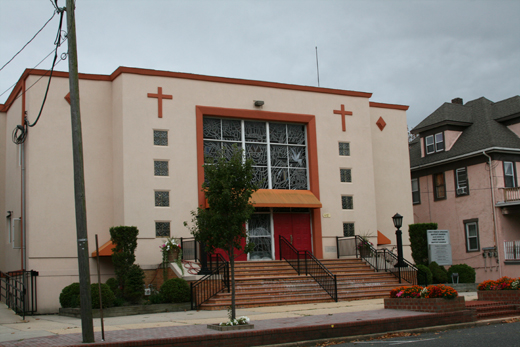
Congregation Sons of Israel in Asbury Park, now a church
Congregation Sons of Israel in Asbury Park, an Orthodox Jewish congregation, was founded in 1904. The congregation has since moved away from Asbury Park, but for several decades it was housed in this building in Asbury Park. A few weeks ago we rented a four wheel cycle (pedal car) from Brielle Cyclery on the Asbury Park boardwalk and cycled past the building, which now belongs to a church (First French Speaking Baptist Church).
The building now has two large crosses in the front: one has to look carefully to see signs that it was built as a synagogue. Details to notice are the stained glass windows.
What do you see in those windows? I see a Torah, menorah, ner tamid, a book, a dove, and possibly someone praying in a prayer shawl on the right.
Also, if you look carefully at the carvings in the front you will see the Hebrew date of 5709 and the corresponding Gregorian date of 1949, the year the building was built for Congregation Sons of Israel.
The 1920’s saw a lot of development in Asbury Park, including this casino. Unfortunately, unlike other buildings that were redeveloped in the past decade, the casino still seems to be just a frame of a building now.
The decline of the prominence of Asbury Park began in the Depression, and competition from shopping and amusements in other parts of New Jersey continued its decline. When my husband first took me on a tour of Asbury Park in the early 1990’s, it looked quite decrepit. In the past decade, however, buildings such as the Paramount Theater below were redeveloped. I posted another shot of the Asbury Park theatre in 2010, with a bit of its history. You can visit some cool shops like this one inside the convention hall and beside the boardwalk.
Pictured above is the Berkeley Carteret hotel, with the famous Tillie face in the foreground on the Wonder Bar. The hotel has a bit of personal history for me: when I was pregnant with my first child in the 1990’s, my brother-in-law knew the caterer who was working at the hotel during Passover. So he invited us to come and enjoy the bountiful buffet at the hotel. Unfortunately, I had morning sickness and could only eat the cucumber salad.
One of the amusements near the Asbury Park beach is this gigantic chess set.
Asbury Park Jewish history is one of the synagogue Sons of Israel: in 1904 the Orthodox Jewish community in Asbury Park incorporated as the Sons of Israel. My husband’s family belonged to this synagogue; sadly, it needed to sell the synagogue building and move out of Asbury Park in the 1980’s.
Interview with Iola Caplan: Iola Caplan is a friend of mine who now lives in Highland Park, New Jersey. In this interview, she talks about living in Asbury Park in the 1950’s and 60’s, including living through riots in 1967. She relates that the Hillel School also got its start in Asbury Park.
JPiX is the Jewish Photo Bloggers’ Blog Carnival. Click on each thumbnail to view original post.
Three by Batya: Herodian ruins, shopping mall, Old City of Jerusalem
Three by Sharon of Real Streets of Jerusalem: fruit stand, Gan Sacher on Israel’s 64th birthday, Jerusalem Day
Left: chol hamoed Pesach visit to the Israel Museum in Yerushalayim by Mrs. S. and Right: Ari Sephardi Synagogue by Laurie Rappeport courtesy of Daled Amos
Left: New Season of Archaeological Digging at Tel Shiloh by Yisrael Medad; Middle and Right: Yemin Moshe, a tiny neighborhood in Jerusalem, near the Old City; and Tower of David by Toby
Left: sunflower bud by Jewaicious; Middle and Right: Poppy and fence; Golden Hour by Robin
Three photos by Leah: Pidyon haben, framed Kotel photo, Lag B’omer collage detail
Three by Leora: Chametz burning, Lavan, Yaakov and Rachel, cherry blossoms
Lavan, Yaakov, Leah or Rachel
My daughter and her friend worked very hard on this diorama for her school’s Torah Fair. It’s sort of like a science fair, explained my husband, except the subject matter was all from the book of Breishit. My daughter’s project depicted the wedding of Yaakov and Leah. Or was it Yaakov and Rachel? In any case, for those of you who don’t know the story, Yaakov first had to work seven years to marry Leah. He thought he was marrying Rachel, but Lavan, Leah and Rachel’s father, tricked him into marrying Leah. After seven more years, he got to marry Rachel. Poor Leah – I once did a painting of Leah crying.
In other news, my eldest son graduated from high school, which emotionally is charged for me – how could my first baby be a high school graduate? We discussed in the car on the way home what is the meaning of “real life” – does being a high school graduate mean one has entered the real world? According to my niece who just finished her first year of college, college is not real life.
Have any leftover matza? See any matza for sale and wonder what one might do with it? Here’s an easy dessert I made with my daughter during Passover.
Ingredients:
1 bag chocolate chips
1 sheet of matza, broken into pieces
1/2 cup of your favorite nuts (walnuts, almonds or pecans) broken into pieces
Paper plates, a large spoon and wax paper
If you want, you can soak the nuts for a few hours to make them more chewable. Melt the chocolate chips in a saucepan. Add broken matza and nuts and mix with the chocolate. Put a sheet of wax paper on a paper plate (the flat white kind that one puts in the microwave work best). Put a spoonful of the chocolate mixture unto the wax paper. Repeat until you have filled the wax paper (you can probably fit about 5 or 6 of these on a paper plate). Repeat on another paper plate (our mixture made two platefuls). Place flat in the freezer. Serve straight from the freezer.