This week’s parsha, Parshat Beshalach, is full of women heroes. We’ve got Miriam singing in the Torah portion. Then in the haftorah, Devorah leads the people, Yael tricks and kills Sisera, and Sisera’s mother cries:
“Why is his chariot so long in coming?
Why don’t I hear the clatter of his chariots?”
She is just darn convinced her son is going to show up again. But he doesn’t. He’s dead.
Turns out, that we blow the shofar on Rosh Hashana 100 times because according to tradition, she cried 100 times. How interesting, that this woman about whom we know so little, other than she was the mother of the story’s “bad guy”, can have such an influence. Maybe it speaks to the power of a woman’s emotional world? And how if it’s a mother, even our rabbis can relate to her pain? Somehow, the crying at the loss of a son (or the not knowing where a son is?) is related to our crying unto God?

Yael Unterman wrote an essay on the topic of “The Voice in the Shofar: A Defense of Deborah” published in Torah of Our Mothers: Contemporary Jewish Women Read Classical Jewish Texts. Yael Unterman proposes that the only reason why we even know about em Sisera, the mother of Sisera, is because of Deborah’s song. Furthermore, Deborah knew that Sisera was dead, long before Sisera’s mother knew. Deborah is called “em beYisrael”, in parallel to em Sisera. Literally, em beYisrael means mother in Israel, but Radak suggests here it means mother to Israel. Deborah, too, is a mother…mother to all of Israel.
So why, according to Yael Unterman, is em Sisera chosen to take central role in associations surrounding the shofar blowing on Rosh Hashana, equal or maybe even superseding Sarah?
Sarah is crying for what has already happened… if she did believe her son Isaac is dead, she crying in grief; if she is aware he is alive, she is crying in shock. About em Sisera, Yael Unterman writes:
As we watch her, we know her son is already dead; and on one level, em Sisera knows this too and her signs and groans are, like Sarah’s, that of a mother who has actually lost her son. Yet on another level, she is still at a point in time where she may reassure herself, imaginging her son is still alive and is victoriously bringing home the booty.
(snip)
…em Sisera’s condition of dialectical emotions and time-frames is a model for us as we hear the shofar on Rosh Hashanah: it evokes grief and loss, but also hope. The groan of the shofar arouses deep feelings of alienation and lack of sense of self: on the Day of Judgement we are stripped of our standing and of the delusions we hold dear the rest of the year…
There is much more to Yael Unterman’s essay, but perhaps I got you interested enough to read it yourself. I took a peek at Yael’s website and discovered she is working on a biography of Nehama Leibowitz.
To finish up this post, I would like to remind (or inform, as the case may be) you of the ritual of dipping one’s finger in the wine cup on Pesach to take out a bit of wine. Even the though the Egyptians drowned in the sea, they are still human beings, and we cannot be completely happy at the death of our enemies.
Rabbi Bassous devoted his speech this past Shabbat to learning from the cemetery vandalism in New Brunswick. I missed the speech (my daughter had other plans for me), so I apologize in advance to Rabbi Bassous if I botch my summary of what he said. My husband related to me that he spoke about two topics:
1) Even when you are dead, you may still not be at rest. Vandals can still attack your grave.
2) It is important to raise children from an early age to respect property. This can start with teaching children to pick up a candy wrapper from the floor. Unfortunately, the teens involved in this incident were not raised to respect property.
=======
My husband pointed out that if the teens were tried in a Jewish Halachic court, they would be considered adults. In the American judicial system, they are considered juveniles.
In my searches on the web, I discovered that cemetery desecration is all too common a pastime for some teens. Clearly, there are a lot of parents out there NOT teaching their children to respect property, especially buried dead people. On one forum, I found young men bragging about their exploits, and saying the only reason why this is getting such publicity is because it is a Jewish cemetery. Sad. And scary.
This week my husband asked:
Why is the Korban Pesach (the sacrificial lamb) roasted?
You can come up with your own answer, but his answer was because it is a sign of a rich person. When you roast a piece of meat, much of the fat drips away. A poor person would lament the loss of much of the meat. But a rich person is OK with parting with all that fat. It is yet another sign of freedom.
 Which reminds me that when I started this blog, I intended to write about food and “you are what you eat”. So I’ll get started here, by saying: pay attention to how you cook the food, as well. Quick broiling is a healthy way of cooking. I am a big fan of steaming vegetables; I own three steamer inserts for my pots.
So maybe I haven’t blogged much about food, food choices and cooking methods because it comes across too preachy. And also, if you think my family only eats healthy food, hah! We do (the adults, anyway) have a tendency to sit around and discuss the junk food after we eat it. My eldest son at a young age could read the sugar amounts on cereal boxes and complain that the ones I bought did not have enough sugar.
I’ll save my complaints about kosher bakeries and hydrogenated fat for another post.
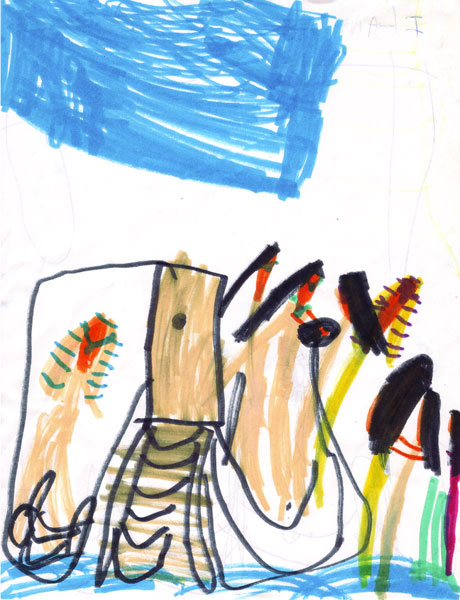
 When I was in 5th grade, I had to write a paper on a plague. One of the ten plagues. So I chose Darkness, חֹשֶׁך . I remember drawing dark figures on yellowy manila construction paper. Sort of the like the image on the right.
The inspiration for this is Rashi’s commentary that there were two three day periods of the darkness. Why should it say ‘three days’ twice? During the first period the Egyptians could not see each other. During the second, no man could arise from his place.
I remember trying to visual people being paralyzed in their places. I also have a vague memory of classmates joking about Egyptians being stuck on a toilet, if that’s where they were.
So now as an adult, I like viewing the division of darkness into three types: physical, emotional and spiritual. The physical is what I have already described. Emotional would be like depression; one feels in a deep, dark gloom, but then when the darkness lifts, the feeling is freedom. Finally, for the spiritual or moral darkness, I will quote Rabbi Jonathan Sacks:
The greatest god in the Egyptian pantheon was Ra or Re, the sun god. The name of the Pharaoh often associated with the exodus, Ramses II, means meses, “son of” (as in the name Moses) Ra, the god of the sun. Egypt – so its people believed – was ruled by the sun. Its human ruler or Pharaoh was semi-divine, the child of the sun-god.
In the beginning of time, according to Egyptian myth, the sun-god ruled together with Nun, the primeval waters. Eventually there were many deities. Ra then created human beings from his tears. Seeing, however, that they were deceitful, he sent the goddess Hathor to destroy them; only a few survived.
The plague of darkness was not a mofet but an ot, a sign. The obliteration of the sun signaled that there is a power greater than Ra. Yet what the plague represented was less the power of G-d over the sun, but the rejection by G-d of a civilization that turned one man, Pharaoh, into an absolute ruler with the ability to enslave other human beings – and of a culture that could tolerate the murder of children because that is what Ra himself did.
When G-d told Moses to say to Pharaoh, “My son, my firstborn, Israel” He was saying: I am the G-d who cares for His children, not one who kills His children. The ninth plague was a Divine act of communication, that said: there is not only physical darkness but also moral darkness. The best test of a civilization is: see how it treats children, its own and others’. In an age of suicide bombing and the use of children as instruments of war, it still is.
Newswire update:
New Brunswick, NJ – Four teenagers have been arrested in connection with the damage done to nearly 500 headstones at the Jewish cemetery, a rabbi from one of the two synagogues that uses the cemetery said.
Received through a synagogue email:
The Jewish Federation of Greater Middlesex County stands with the community in expressing shock and sadness at the desecration and vandalism at the Poile Zedek Cemetery in New Brunswick.
Federation has teamed with Congregation Poile Zedek, Congregation Etz Ahaim, Rabbis, cemetery officials and the organized Jewish community to assess the damage and provide the support necessary to begin to heal and rebuild. We have approached law enforcement officials, the Mayor of New Brunswick, and the county prosecutor’s office in an effort to maintain open lines of communication. Federation, representing a united Jewish community, is in pursuit of a full-scale, rigorous investigation into this heinous crime, which is an affront to us all.
As we examine all avenues of effectively providing aid and comfort to those impacted and concentrate on putting together a formal plan of action, we are confident that we can count on your support during this trying time for our community. In that vein, we have established a fund for the repair and restoration of the cemetery. Donations can be sent to the Jewish Federation of Greater Middlesex County, earmarked “Cemetery Restoration Fund”. 100% of your donation will be directed toward this fund. Our address is 230 Old Bridge Turnpike, South River, NJ 08882. If you need more information, contact us at 732-432-7711 or [email protected]. You may also donate on line by logging onto our website at JewishMiddlesex.org.
Headline: Vandals tip tombstones, trash graves
Are we in Eastern Europe? The former Soviet Union? No, no, this took place right here in New Brunswick, New Jersey. Nathan Reiss of Congregation Etz Ahaim said Sunday’s vandalism at the Poile Zedek Cemetery came days after a similar incident was discovered on Thursday. Families of the buried will have to pay for all this damage. Many of these families are descendants of immigrants from Salonika and Turkey, hard-working people who became model American citizens. Read more about some of the families in Voices of Etz Ahaim. Others are Holocaust survivors, such as Menachem Simcha.
My husband said it will cost $200 and up just to repair one headstone. Some are not repairable. 499 headstones toppled.
Finally, the police is now calling this a bias crime. See the comments on Dov Bear.
“To say it was premeditated is an understatement,” said Poile Zedek administrator Caryn Lipson. “It had to be hours and hours of work by several people.”
From the Star Ledger:
Jack Oziel picked his way through the ruins of the vandalized Jewish cemetery yesterday, surveying hundreds of headstones toppled like dominos or lying in crumbled heaps.
He managed to locate the fragments of a granite Star of David that had marked his father’s grave lying on the grass. His mother’s tomb had cracked in half. And everywhere else Oziel looked, he saw more headstones of family and friends knocked down.
“I knew them all. I buried all these people. Now they are all in pieces,” Oziel, 91, said with red eyes as he surveyed the damage at the Poile Zedek Cemetery in New Brunswick.
And I know Jack Oziel. So I feel like I know all of those people buried there, too.
How can this be prevented? A surveillance camera? And who would do something so nasty?
 One morning when Paro awoke in his bed
There were frogs in his bed, and frogs on his head
Frogs on his nose and frogs on his toes
Frogs here, frogs there
Frogs were jumping everywhere.
Listen to my daughter singing the song …
(Frog is drawn by me…a quick sketch with the pencil, then scanned into the computer and the greens were added in Photoshop.)
This post is dedicated to my dear friend Heidi Rosen and her mom, z”l (may her memory be a blessing). Hamakom yinachem otah b’toh avlai Zion v’Yerushalayim…
Heidi’s mom died after a long battle with cancer. This is also for all dear moms and daughters everywhere.
 “Shemot is the best parsha in the universe!” declares my daughter. And no wonder…it’s action-packed, with women heroes, defiance of a totalitarian dictator, and the Children of Israel enslaved, but not for long. For her, the best part is how little Moshe is taken from the water by the daughter of Pharaoh. Miriam is standing nearby, and the daughter of Pharaoh’s servants are close by as well. Miriam will soon get her mother, Yocheved, to come nurse her own baby. See my daughter’s rendition of this event by clicking on the thumbnail.
When Moshe is born, Yocheved sees that he is “good”, ‘ki tov’. Aren’t all little babies good? Rashi explains that when he was born, the whole house filled with light. Rashi is referring to a midrash that it was supernatural sign, and therefore she hid him. He is alluding to the light from Breishit, where it also says ‘ki tov’, and it was good.
In his book Exploring Exodus Nahum Sarna points out the language here is not only an echo of Breishit, but later, when Yocheved places Moshe in a basket, it is called a ‘tevah’, echoing the language of parshat Noah.
These two literary allusions tie the book of Shemot (Exodus) back to the book of Breishit (Genesis). Just as God created the World, so He is the one who saves Moshe and will take the Children of Israel out of Egypt.
Sarna writes further about the word ‘suf’:
The container that held the infant Moses was placed among the “reeds”, in Hebrew suf, a term borrowed from the Egyptian for “papyrus/reed thicket.” The idea of the mother was to make sure that the infant would not be carried downstream. It may well be that the rare word suf has been selected in the present text because it is allusive, prefiguring Israel’s deliverance at Yam Suf (Sea of Reeds).
And for your listening pleasure, be sure to check out Ka Ribon by Pharaoh’s Daughter.
 Attention local history buffs! Here’s a book you won’t want to miss:
Voices of Etz Ahaim. Nathan Reiss and Seth Rubenstein paired up to create a wonderful collection of biographies of many of the diverse congregants of Congregation Etz Ahaim, a Sephardi Orthodox synagogue in Highland Park, New Jersey.
Learn about how Rabbi David Bassous was born in India, grew up in London, became a rabbi in Israel, had his first pulpit in Vancouver, and then came to Highland Park. Liselle (Elisheva) Badache grew up in war-torn Algeria. Behzad Hakakian, brother of Roya Hakakian, speaks of growing up Jewish in Iran. One of the oldest members of Etz Ahaim, Al Benzilio, whose parents were from Salonika, reports on the original building in New Brunswick, and how the synagogue was named after one in Salonika.
Pictures enhance each of the biographies. Twenty two people of varying ages and backgrounds were interviewed for the book.
The book is available via the Etz Ahaim website, store.etzahaim.org; from there, click on ‘Books and CDs’ to order the book. There is one copy in the reference section of the Highland Park Public Library.
 A beautiful song is in this week’s parsha of Vayechi. The scene is Yaacov on his deathbed, blessing his grandsons Ephraim and Menashe. Part of the blessing has become a pretty song that parents often sing to children at bedtime.
Translation in English:
“May the angel who redeemed me from all harm bless the youths, and may they be called by my name and the name of my fathers, Abraham and Isaac, and may they grow into a multitude in the midst of the land.”
Transliteration:
Hamalach hagoel oti,
Hamalach hagoel oti mikol ra
yivarech et hana’arim v’yikaray bahem sh’mi.
V’shem avotai, V’shem avotai Avraham v’Yitzchak,
v’yidgu larov, v’yidgu larov b’kerev ha’aretz.
Click on the little girl to see the same little girl with Play and Pause buttons. Click on Play to hear my daughter (and me) singing the song. Or click here for song. (I couldn’t get the Flash to embed directly in this post; seems like one may need a plugin for this.)
Rashi states that “the youths” refer to Ephraim and Menashe. But I like to think of the youths as any kids that are in the room at the time the song is being sung.
For a hilarious post on how someone argued that children are supposed to get into trouble, because after all, the angel isn’t preventing the children from harm but redeeming them, see Maggid of Bergenfield.
For a scholarly post on how we Jews don’t usually worship angels, please read Josh Waxman’s post.


